
AI-Powered Energy Audits: How Smart Thermostats and Thermal Imaging Are Lowering Grid Dependency
While commercial solar farms and industrial microgrids have been the focus of energy independence, the field has taken a turn for the ordinary homeowner, down to the residential driveway. Today, homeowners are no longer content to cut a few dollars off their electric bills; they’re searching for a way to break free from the grid with cutting-edge technology. At the helm of this revolution is a potent AI and thermal imaging duo that’s revolutionising how energy is used, tracked, and saved in the home. Combined with deep-learning software and predictive algorithms, residential homes are becoming more than just consumers of energy; they are now self-regulating, intelligent ecosystems.
The intelligent climate control for optimal comfort and energy efficiency is evolving.
In the same way that guides on how AI is changing the future of home automation explain the software infrastructure that makes modern AI possible, it’s important to look at the software that makes these capabilities possible to understand how AI is changing the way home operations are managed. Older smart thermostats were manual and hard-coded and could never lead to any significant energy savings without user tuning. But next-generation machine learning algorithms do not rely on fixed schedules but learn the behaviour patterns of each occupant continuously. They study local weather patterns, thermal mass and occupancy data to pre-cool or pre-heat spaces prior to high-energy tariff times. This integration runs seamlessly, with no compromises in terms of comfort, and also allows for a much reduced dependence on the grid.
Harvesting Unlocking Hidden Efficiency Through Thermal Imaging
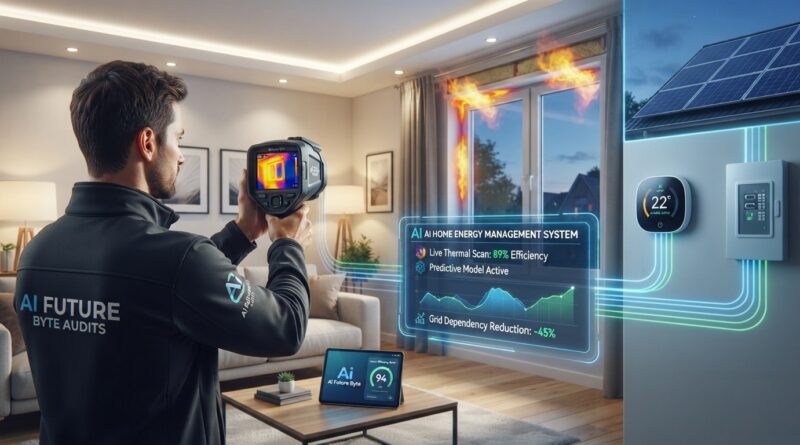
In addition to behavioural changes required of smart thermostats, the physical shell of a house is crucial in determining how much energy it holds in. Thermal imaging is a game-changer in diagnostic home audits. In the past, checking for air leaks, thermal bridging and insulation issues required knowledge of how to do it or a guess. In today’s world, a combination of high-resolution thermal imaging cameras and AI algorithms can scan the heat signature of a house in seconds. It also analyses the infrared images to accurately detect small pockets of air leakage around window frames, areas of missing attic insulation, and damaged HVAC ductwork. Combining these diagnostic elements is the foundation of any high-end Smart Energy System in Modern Home setups, and enables the automated routines to dynamically adapt zones to structural weaknesses.
The entire process of self-examination, as conducted throughout this group, is known as Continuous Self-Auditing for Ultimate Sovereignty.
Combining continuous behavioural data from smart learning devices with structural data from thermal scans creates the equivalent of an energy audit in the home that is continuous and automatically completed. The home’s central AI engine constantly audits the efficiency of the home by itself, rather than having to wait 10 years for a professional energy auditor to arrive. It can sense when a smart window blind should close to reduce solar heat gain or alert the homeowner if an appliance is consuming excessive power, meaning it may be inefficient. These automated micro-adjustments add up over time to greatly reduce waste and reduce the reliance on the grid during peak hours.
The potential impacts of these technologies go far beyond saving households money, encompassing all aspects of life in the 21st Century as detailed in resources focusing on Ai & Tech. With increasingly sophisticated machine learning models, residential ecosystems will effortlessly interact with neighbourhood-scale VPPs, exporting any PV surplus to the grid during peak demand periods and importing energy at minimal cost during periods of peak energy price. In conclusion, the integration of AI-powered thermal analysis and smart climate control systems is a game-changer in the realm of sustainable, self-sufficient home design.
Conclusion
With the advancement of technology, the application of artificial intelligence and advanced thermal diagnostics will keep improving, and the way our homes use energy will be forever changed. Using passive spaces to create active, self-monitoring spaces, homeowners can significantly reduce energy bills and reduce their environmental impact. The adoption of these innovative tools is not a luxury upgrade, but rather a crucial step towards achieving long-term sustainability, climate resilience, and absolute grid independence.
