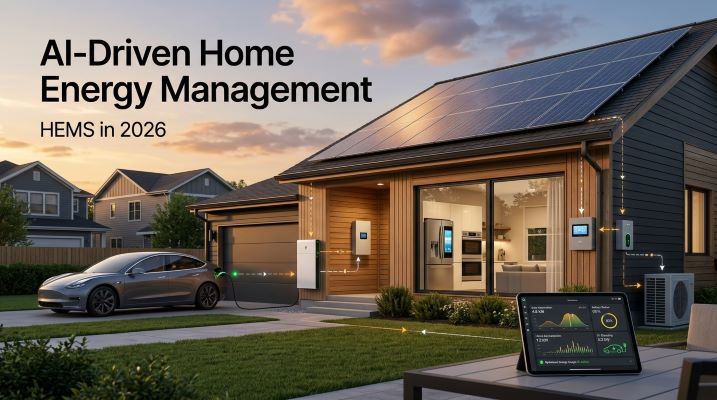
The Rise of AI-Driven Home Energy Management Systems (HEMS) in 2026
Households are becoming active producers of energy in the modern Smart Energy System, a paradigm shift taking place in the global energy landscape. As demand for power continues to grow and as weather patterns become more unpredictable, traditional power grids are becoming increasingly stressed, and homeowners need better alternatives. In response to this, artificial intelligence has come to the rescue, transforming regular homes into smart homes that can handle their own electrical needs with autonomy.
One of the key components of this revolution is Home Energy Management Systems, or HEMS. These systems monitor, control and optimise all of the kWh of electricity that flows through a home. Original models provided basic timers and controls, but current AI-driven models serve as the “brain” of the home. They analyse huge amounts of information in real-time, adjusting to market conditions and learning family habits without needing to make any manual adjustments by the homeowner.
What is a Home Energy Management System and Why AI Matters
Home Energy Management System is a specialised set of software and hardware to monitor and control the use of electricity in the home. These systems without artificial intelligence are simply reactionary dashboards that illuminate usage of energy retroactively. AI turns the tables by introducing a proactive and predictive, instead of just historical, component to the system.
The machine learning algorithms learn from the daily routine of the occupants, the efficiency of the various appliances, and the weather forecast in the area, and predict the power demand. The software learns over time when the house consumes the most power and plans for that peak power usage. The shift from manual switches to automated decision making means that there is no wasted energy in idle appliances or inefficient operational cycles.
The Core Role of Machine Learning in Energy Efficiency
The models that leverage machine learning are the ones that form the backbone of today’s energy optimisation systems for homes. These algorithms are constantly learning the specific behaviours of each individual in the household. They know when specific rooms are in use and automatically adjust the climate controls and lighting.
Machine learning can go beyond behavioural tracking and be used to optimise heavy energy loads, such as electric vehicle chargers and heat pumps. The system is able to anticipate when these power-hungry appliances are going to be utilised and distributes power loads across an extended period to prevent overwhelming the home’s main electrical panel. This smart load balancing solution extends the life of household appliances and maintains low utility bills.
Key Drivers Fueling HEMS Adoption in 2026
This year, several strong economic reasons are driving the uptake of HEMS platforms. The rising rates of utilities in key global markets have put consumers on a quest for quick cuts to their bills. Automated energy management offers a direct way to fight these ever-higher energy costs with algorithmic energy savings.
Meanwhile, rooftop solar panels and household battery packs have been installed across the country, creating a technical management challenge for homeowners. Self-generated power is not something that is easy to control, let alone manage, when combined with the grid. The gap between generation and consumption is now to be bridged by software automation.
The role of AI in optimising power consumption in a smart energy system is crucial.AI’s contribution to power consumption optimisation in a smart energy system is key.
Indoor environments do not live in isolation, but they constantly depend on the rest of the Smart Energy System infrastructure. AI seamlessly connects home appliances and smart utility meters. This link enables the home to respond immediately to grid signals.
One of the key aspects of this interwoven grid system is real-time dynamic pricing. Electricity prices fluctuate frequently during the day based on wholesale electricity prices. Advanced HEMS keeps track of these price changes on a second-by-second basis and automatically reduces energy use when electricity charges reach high levels, or charges from battery power when electricity is unavailable.
Predictive Weather Analytics and Solar Power Management.
Solar power generation is highly erratic and subject to clouds, seasonal changes and sudden weather deviations. For advanced HEMS platforms, they are able to combine live meteorological data feeds with predictive weather models to predict solar yields hours ahead of time.
When it determines it will be cloudy the next day, the system changes its charge schedule, drawing the cheaper electricity from the grid into batteries overnight. This planning helps avoid unforeseen energy shortfalls and helps the household never be left with a sudden lack of renewable energy.
Here are some critical features of next-generation HEMS platforms.
Advanced home energy software includes advanced features to simplify complex home automation tasks. One of the most sought-after functionalities is automated EV smart charging, which aligns vehicle charging with periods of peak sun and lowest tariff.
Another important function of predictive HVAC optimisation is that it learns family temperature preferences and pre-cools or pre-heats the house when energy is cheap and its windows are open. Moreover, some appliances can be monitored for their health and provide a warning to homeowners when subtle variations in their energy consumption indicate mechanical trouble, long before an actual failure.
Although AI-powered energy management has a lot of promise, it also has its hurdles.
While the potential for AI-driven home energy systems is significant, there are a few unique challenges that must be addressed for widespread deployment. Upfront investment is a major hurdle: The investments needed to buy the “smart” breakers, compatible batteries, and higher control hubs are significant.
Data privacy and cybersecurity are also significant issues because of the systems’ ability to monitor private patterns of in-home activity. Comprehensive end-to-end encryption is essential in order to guard against illegal access to domestic data networks. With the growth of technology, though, these security systems are quickly improving.
For the future, home energy systems will be increasingly connected to CL-VPPs. If a home battery system has more electricity to offer than is needed, it can feed back into the grid or be shared directly with nearby residents to enhance the decentralised and resilient green energy economy.
