How AI and Drone Technology Are Revolutionising Roof Maintenance and Damage Repair
Estimating structural integrity and repairing structures have always been done visually and manually, with the use of physical ladders, in the roofing industry. But the merger of Artificial Intelligence (AI) and Unmanned Aerial Vehicle (UAV) technology, often referred to as drones, is bringing a significant change to this traditional industry. Modern technology is setting new benchmarks in roof maintenance and damage restoration for safety, accuracy, affordability and speed by eliminating unsafe manual climbing and the judgment of human inspectors with autonomous flight paths, ultra-high-resolution imaging and predictive analytics. These developments are also becoming an important part of 2026 roofing trends, as technology continues to influence modern roofing and home improvement strategies.
The Technological Change in Aerial Roof Inspections
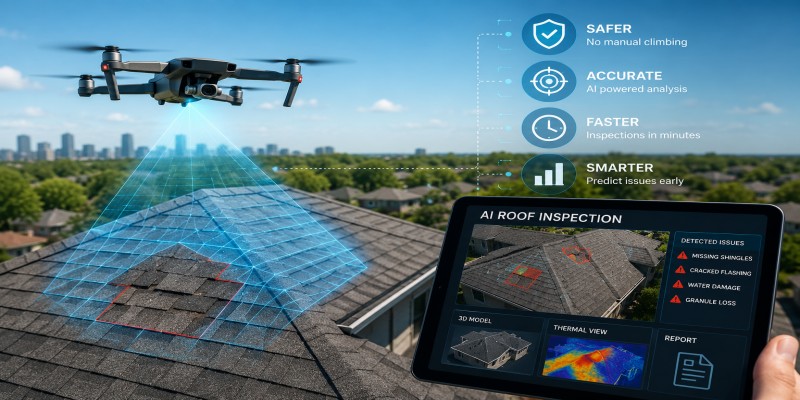
Conventional roof evaluations are quite challenging to perform. Inspectors need to climb on steep structures and use tape measures and simple photography to document damage manually while scaling the slippery surfaces. It is a process that is inherently risky, labour-intensive, and subject to human error or incomplete documentation. This is now being changed by drones equipped with sophisticated sensor packages that can collect all the required external information from a safer, higher vantage point.
Advanced Sensors and Autonomous Flight
Commercial drones used for roofing, however, are equipped with more advanced technology than consumer cameras. These airborne systems include high-resolution RGB optical sensors, thermal imaging units, and Light Detection and Ranging (LiDAR) equipment to capture incredibly detailed footage of structural elements. Moisture under shingles can be located before internal leaks occur in a building by capturing the minute variations in heat across a roof membrane using thermal sensors. LiDAR sensors produce accurate “point clouds” that enable the mapping of roof structures down to the millimetre, including the shape of the geometric outline. Moreover, there’s a chance to map an entire property by using a constant altitude and angle throughout the coverage of the drone’s images, thus eliminating the need to control the drone manually.
Collecting high-speed and spatial data.
As opposed to a manual roof inspection that can take up an entire afternoon on a complex commercial building, an autonomous drone mission can collect the same or better data in 15-20 minutes. Using photogrammetry software, the acquired imagery is stitched together to create a single, high-resolution 3D digital model from hundreds of overlapping aerial photographs. This digital twin will be a detailed visual document to allow inspectors, adjusters, and structural engineers to analyse every square inch of the roof surface in a remote computer environment, without having to climb a ladder. This approach can also support cool roof energy savings by helping property owners monitor roofing conditions and identify areas that may affect energy efficiency.
The role of Artificial Intelligence in Damage Assessment.Artificial Intelligence in Damage Assessment.
The hardware of the drone is important in enabling the logistics of data collection, but Artificial Intelligence (AI) is what gives it the analytical brainpower needed to convert raw imagery into actionable insights. During drone flights, there is an enormous amount of spatial data generated that is fed into advanced machine learning models, allowing them to detect anomalies and structural defects at an astonishing speed and accuracy. This type of AI tech is becoming increasingly relevant to modern home improvement, where intelligent systems are being used to improve the inspection and maintenance of residential properties.
Automated Defect Detection and Computer Vision
AI algorithms are trained with gigantic data sets of millions of annotated roof images using deep convolutional neural networks. Therefore, they recognise the signs of wear and weathering, and the degradation of materials very quickly. The software identifies missing, broken and misaligned shingles, leaking or damaged flashing, rusted nails and bolts, ponding water, hail damage and granule loss on asphalt. Using a computer vision system, hundreds of aerial photos can be quickly and accurately inspected, with results showing all defects in seconds and severity ratings indicating which areas are in need of repairs.
Predictive maintenance and thermal analysis.
In addition to detecting current surface defects, AI can also be used to implement predictive maintenance strategies using thermal imaging. Moisture intrusion is one of the most destructive factors in structural roofing, where it can be invisible until significant internal damage is done. Using AI algorithms, thermal gradients that are recorded in the post-sunset drone flights are used to map areas where the wet insulation has a different heat-retaining capability than the dry insulation. Building managers can identify wet spots before they become serious and can replace smaller areas of wet insulation and fix small tears in the roof’s membrane integrity to avoid extensive roof takeover and the thousands of dollars in remediation costs. These predictive capabilities align with broader smart home trends 2026, where intelligent technology is increasingly focused on identifying problems before they become expensive repairs.
Simplifying repair processes, insurance claims, and safety requirements.
AI and UAV technology is being used to do more than just diagnose the issue – it is helping with the entire roof restoration process, insurance claim processing, and workplace safety compliance.
Insurance claims are a process that needs to be revolutionised.
After a severe weather event like a hailstorm, hurricane or tornado, insurance adjusters are left with backlogs of roof damage claims. Drones can be deployed quickly in disaster areas, providing objective data which cannot be disputed. The detailed damage reports are automatically generated by the AI software, which will include exact measurement calculations, surface area calculations, slope pitches, and annotated defect maps. This automated output not only ensures that the insurance process and homeowners have clear, verifiable documentation, but also speeds up claim approvals, curbs fraudulent claims and shortens the time from storm damage to repair initiation.
Eliminating Workplace Hazards
Continued advances in occupational safety are among the biggest factors leading to the increased acceptance of aerial technology in the roofing industry. One of the most common causes of severe injuries and deaths in structural construction is fall-related injuries. With autonomous drones carrying out primary inspections, measurements and tracking of progress, contractors can dramatically reduce the number of times workers are exposed to heights, steep pitches, or unstable roof decks. Physical access will be provided mainly to perform essential repair work and will be made much safer for technicians.
Improving the accuracy of material estimation and repair execution
Poor material estimates result in material waste, budget issues and project delays. The automated photogrammetric analysis provides hyper-accurate measurements of roof facets, hips, valleys, ridges and eaves directly from the drone flight data. These precise calculations are used by repair teams to order the exact quantity of replacement materials, ensuring an optimised logistics chain and avoiding environmental waste. Mid-project drone sweeps are used during repairs to keep track of the progress and ensure that the installations comply with structural codes and the manufacturer’s specifications before the project is deemed complete.
Future of smart roofing management
The future of AI and drone technology in the roofing industry will usher in a new age of proactive asset management, as both computer vision models and drone battery technology continue to advance. Future developments indicate the installation of autonomous stations for housing a permanent drone on a significant commercial facility, which will fly automatically periodically to monitor structural wear over decades. Predictive analytics, combined with alerts from the system, will enable property owners to receive alerts on the specific remaining lifespan of each roofing material, meaning they can plan for preventive maintenance instead of emergency repairs. By combining aerial mobility and machine intelligence, roof maintenance is becoming a safe, fast, accurate, and truly efficient field. These developments also connect with emerging 2026 roofing trends, smart home trends 2026, and the wider use of AI tech in modern home improvement.
